
Interview with Dennis
Give to ensure Dennis Prager’s timeless wisdom continues to inspire young Americans for years to come!
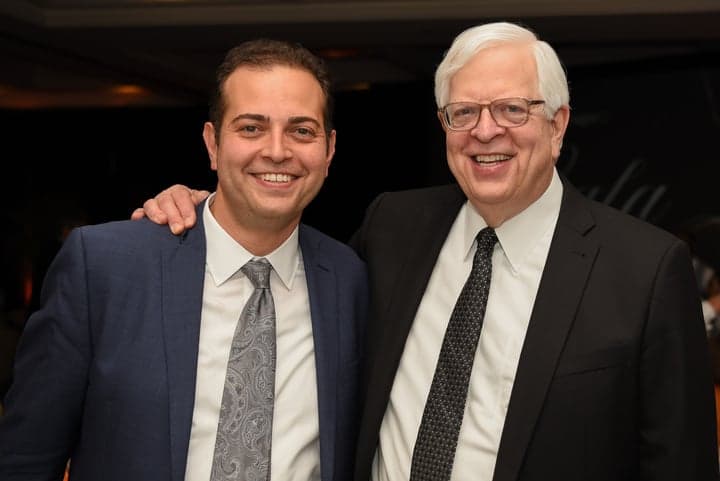
For decades, Dennis has inspired many while dedicating his life to teaching the principles of ethical monotheism from the Bible—insights that formed the foundation of Western Civilization and America’s founding principles.
While you have not been able to enjoy new Fireside Chats with Dennis recently, please enjoy this recent conversation with his son, David.
Dennis Prager Answers Life’s Hard Questions
On August 26, 2025, David Prager recorded an interview with his father, Dennis, at the hospital, where Dennis has been for nearly five months following a spinal cord injury sustained nine and a half months earlier. The following is the full transcript.
QUESTION #1
David:
I want to ask you, dad, in general, relative to how you've been since the accident, how are you currently feeling?
Dennis:
Well, everybody asks that. That's the American way of saying hello. Hiya doing? And I try to always be real so I don't give some normative answer, like, oh, fine. So I tell people it's a very complex question. I'm paralyzed from just below the shoulder to my toes. I can't move my arms or my legs. That's a heavy blow to someone who traveled the world regularly, lectured all over the place, and flew on average every week of the year. And there's no denying that. On the other hand, I speak better than I have most of the time since November 12th when I fell in the bathroom in my home, stepping out of the shower, wet on a wood floor. My biggest battle since November has been to breathe well. The spinal cord controls so much of our body, and that includes breathing. So I have been working very hard - along with the doctors, nurses, and others - to enable me to breathe normally, and I'm getting there. So in that sense, I'm doing well. Everything is perspective. What do you concentrate on? What you've lost or what you've gained?
David:
So I ask you a four-word question and I get a three-minute answer. I think it's fair to say Dennis Prager is back, or you never left. That's for sure. It's funny because when I see you, I don't see you every day unfortunately, but I see you frequently enough. But when I come back and you're having a good day, you're vastly improved from the previous time that I saw you. Do you see that as well?
Dennis:
Yeah. The emphasis is when I'm having a good day. Right. I often don't have a good day. But the last three days have been good.
David:
Yeah, very good. Maybe the best since the injury.
Dennis:
Yeah. Oh, that's interesting. I have gone 10 days without the ventilator. Breathing on my own 24/7 for 10 days. That was, I don't know, about a month ago.
David:
Yeah, just about a month ago. That was an amazing run.
QUESTION #2 - Depression
David:
So one of the questions that I have is from people's reaction when they've been here to visit you. They said, David, it's amazing. Your dad seems so himself so much of the time, despite having gone through this terrible accident. And like you just said, that with your life being completely turned around. So I think what they're asking is, how is he not depressed? So I guess I'll turn that question to you. Number one, have you been depressed? If so, for how long? And how have you gotten out of it? Or have you been able to not be depressed?
Dennis:
Okay, that's the $64,000 question. So first of all, you'll find it of interest to note. that I asked the same question. One of my closest friends is a psychiatrist, Dr. Stephen Marmer, who's been on the Happiness Hour (Dennis’ radio show) a few times.
David:
He's done a few PragerU videos as well.
Dennis:
And Prager U videos, that's right. And I asked him, in all seriousness, Is there something wrong with me that I'm not depressed? And I have an answer to that. And I'll give it, but first I want to note, I have not been free of it. but it has never lasted more than two days. So it's been rare and it's been short. And frankly, as you know in conversations you and I have had, I'm actually happy that I did experience that. Because it means I'm not in denial. And I'm not in denial. Even in the vast majority of time that I'm not depressed, I'm not in denial. So how have I done this? So I have a number of answers. And one is, I fear depression more than I fear paralysis. I don't like being sad. My biggest nightmare is being pitied. I have too much dignity to allow myself to ever be pitied. And that includes me. I don't engage in self-pity. Another is, from the very beginning, I knew I had only three choices. And they were death, depression, or make the best of my situation. I can't think of a fourth choice. In fact, people who are intimately involved in my life, including my wife, Sue, asked me early on do you think you should have been left to die? Which was the advice of the first surgeon at a major hospital.
David:
Yeah, I was there.
Dennis:
That's right, you were there.
David:
I heard the doctors say it. This took place a few hours after you had your injury, when - and this is not something I knew before your injury - but what you need to have immediately after a spinal cord injury is what's known as a decompression surgery. And the doctor felt as if it wasn't necessary that you should basically be made to feel comfortable, engage in palliative care, because you would most likely not even live past a month.
Dennis:
Yeah, there you go. So I was asked, do you wish that the surgeon's advice would have been heeded? And I love life. My love of life is not diminished because I'm paralyzed and find breathing a challenge, though it's getting much better, happily. So, the second reason is that I had that choice of death, depression, or making the best of my life despite this tragedy. Dr. Marmer on one of my Happiness hours, said on the air to me that I have extremely strong, what is the word?
David:
Shock absorbers.
Dennis:
Yeah, shock absorbers, right. Well, in case anybody needed proof. Here is the proof.
David:
Did you need that proof? Did you feel you won't really know that until you’re truly tested?
Dennis:
No, I did not need the proof. I'll give you a perfect example. 10 or 15 years ago, I assume it was on the Happiness Hour, some caller said to me, again on the air, that he would rather be dead than quadriplegic. And it's very rare that I have ever yelled at a caller. But I yelled at this guy. I said, “are you kidding if you have your mind and your ability to speak you would rather be dead and how ironic that it exactly what I got annoyed about has happened to me, and I have lived at least thus far. I can't predict five years from now, but I have lived my conviction. I love life. I love my wife. I love my children. I love my grandchildren. I love my friends. I love reading. I mean, I love so many things that that hasn't stopped. Unfortunately, my love of fountain pens and pipes is on the side currently. Cigar is still possible if somebody sits next to me.
David:
Maybe not in the hospital.
Dennis:
Yeah, not in the hospital. Not where there's oxygen.
David:
Right. We'll get there. That'll be the next phase.
Dennis:
Next stage, yeah.
Question #3: Realizations
David:
So, the next question I have for you is about realizations that you've had since your injury; of which I don't think you've had too many, because you said you largely knew yourself prior to this injury. But one of those that you said was you’ve developed a higher level of empathy for those suffering. Would you care to expound on that?
Dennis:
So I have a lot to say about that. First, I wouldn't say that there were new realizations. There are heightened realizations. I'll explain, but I just wanted to make that clear. And I'll begin with the empathy issue that I've talked to you about. I have always - I wrote about it, I spoke about it on the radio - had a very strong sense of the effects of evil and of disease on undeserving people. Well, it's always undeserved if it's evil. But anyway, one of the reasons that I have devoted much of my life to fighting evil is my sympathy for their victims. Stalin famously said, or infamously said, One death is a tragedy. A million is a statistic. He was right. For most people – and I don't say this as a criticism, just as an observation – 1 million killed people doesn't mean more than 100,000, even though it's 10 times as many. But I am overwhelmed, always been, at the 60 million Chinese killed by Mao, the 20 to 30 million or 20 to 40 million killed by Stalin, and of course, the 6 million Jews murdered by Hitler. But now it's heightened. When I realize what I'm going through and have been going through The bed wounds or bed sores, as they're popularly called, but they're much more than sores. They can kill you, actually. The challenge to my breathing, the pain in my shoulders from inactivity and so on. All that has heightened and sort of obsessed me with regard to what people have gone through. I think, for example, when I lie here in my hospital bed, that there are people 24/7 working to save me and to reduce my pain. And then I think of people tortured. where they lie maybe on the floor or maybe on some awful mattress, and people are working 24/7 to inflict excruciating pain on them. That's a good example of something I would not have thought about. before. So I have a heightened sympathy. Because you can't empathize with what you don't experience.
I can't empathize with a woman giving birth. I can sympathize, I can imagine, but I can't empathize.
Reminds me of the man from synagogue, whose beloved son was killed in a car crash, I think at the age of 21. I asked him, “Has anything helped you cope with that?” And he said, Only one thing, not religion. And again, he was a member of the synagogue. Not religion, not psychotherapy. The only thing that helped were groups of people who had lost their children. They're the only ones who could fully understand what I was going through. Wow. So that's empathy. Only if you experience it can you empathize. I can't empathize with a person being tortured. I can imagine the horror of it. And I do. But I have never been tortured.
Realization #2: On being loved.
David:
One of the other things that you've remarked to me, Sue and, Aaron and to a lot of the friends who have visited is, and I'll let you put it in your words, but I'll paraphrase, that you always kind of knew that you were respected by people, but you didn't realize how much love people had for you, which I thought was very moving, given the letters that people have sent you, the messages people have written online for you.
Dennis:
Yeah, well, again, I've told you and others that I knew I was respected by many people. Something I feel I've earned. but I never reflected on being loved and what people wrote and spoke, recorded was their love for me and that somewhat surprised me. Not that I thought I was hated, though I am hated in some circles. I even understand why I thought that, and that is because I consciously did not seek to be loved. Because then I would have compromised what I believed, thinking if I said X or Y or Z, would I not be loved? If you, anyone in a situation of responsibility; a parent, a teacher, a talk show host, and that is an opinion molder. Anyone who seeks to be loved rather than respected will compromise their message. And my values are sacred.
David:
And that might be why you're loved, because you're so real with people, that when I think someone, God forbid, gets injured and they miss time on radio or television, the visceral reaction that people had with your injury was more than just, oh, I don't get to listen to Dennis today. I miss his wisdom, sure, but they just truly feel like they knew you and as a result, feel a bigger pain. And I think that that's what you've always said to people is when people say, I feel like I know you, what's your answer?
Dennis:
You do!
David:
Exactly.
Question #4: Loving God
David:
You said instead of realizations, it's more of a heightened awareness of things. What other heightened awarenesses do you have?
Dennis:
Well, I have said and I wrote an article on it a long time ago. The hardest law in the Torah for me to observe was to love God with all my heart and all my soul and all my might (From Deuteronomy). And I further noted that God Himself knows it's hard to love Him, at least for many people. And that's why He has a law to love God. There's no law to love your parents, there's a law to honor them. There's no law to love anybody. I mean, you have the stranger, but not a specific stranger. The only specific being we're commanded to love is God. That's quite something, because God knows it ain't easy.
David:
And how is that? How has that been heightened since your accident?
Dennis:
Well, because you realize how much unjust – there's some justice-based suffering – but how much unjust suffering there is in the world as a result of evil and a result of natural, disease-based suffering. I mean, you know, what percentage of Europe died in the plague? An enormous percentage. I think what did God have in mind and the Torah in its brutal honesty has as one of its most important lines and that is when God saw how much evil there was in the world, and then destroyed it except for Noah and his family, he, “he got sad unto his heart”, which implies to me among other things, that God did not know how bad people would turn out.
After all, He created us in His image. After all, only on the sixth day of creation, when God created the human being, does it say, “And He looked. and saw that it was very good.” All the other days were good, but this day was very good. And then look at what human beings – granted the ability to violate God's will – did with that freedom.
And I just want to add, for those who say, God knows the future. This statement about God getting sad, disappointed, seems to imply that with regard to humanity, with regard to the universe, God may well know the future. But with regard to humanity, he may not know what we will do with our freedom since we could violate his laws.
On the other hand, I can make a case that God knows the future. because he lives outside of time. So I don't know which is true, but it is certainly possible that He does not know what we will do. In any event, when I dwell, as I often do now, on how much suffering there is in the world. It does for me, not for everyone, and thank God. I actually envy those who – like my father – love God effortlessly. I would love to have that ability. But I'm stuck in my rational universe. I have learned, but you'll find this of interest, David, that a reason-based outlook, which I have, that's why I call my Torah commentary, My Bible commentary, the Rational Bible, can be a prison.
David:
How so?
Dennis:
Well, it prevents me from truly loving God.
David:
So when we were talking offline, I had mentioned to you that with God being sad as potentially being proof that God doesn't know what humans are going to do, God is also, of course, anthropomorphized a lot in the Torah, like with having an outstretched hand, he clearly doesn't have an outstretched hand, and maybe it's an ability for us to relate to him or explain why he had to destroy the world and create Abraham.
Dennis:
That's a very good point, as is in that connection that God can relate to what we feel.
David:
Right, right, exactly.
Dennis:
That's the power of Christianity. That God came as a human and suffered.
Question #5: On Israel
David:
I think a lot of people, I know I've been getting this question all the time, saying the world's obviously chaotic and we need Dennis more than ever with his thoughts and opinions. They've also asked what are your thoughts and opinions about what's going on? You've been out of commission essentially since Trump took office.
Dennis:
I'll give you one about Israel.
Israel at this time is the most widely hated country in the world. Given the fact that Israel is one of the most decent countries in the world, for example, one of the greatest experts on urban warfare, a professor at West Point has said that Israel is the most decent country in the world with regard to urban warfare. And given the fact that the charge of genocide is the greatest libel against the Jews since the medieval charge that the Jews killed Christian children to use their blood to bake matzah for Passover. They are precisely equal in their mendacity, in the amount of lying involved.
Given both of those facts, there's no question there is a metaphysical element to Israel hatred and Jew hatred. It's Balaam in Hebrew, the pagan prophet, characterized the Jews correctly as a nation that will rest alone. And that's exactly right. That's the price, one of the prices of chosenness.
David:
And what do you say to people who think that they're not allowed to criticize Israel politically or militarily, and they say that this is a form of cancel culture?
Dennis:
Oh, I thought you were going to ask something else, that any criticism of Israel is called anti-Semitic.
That's another libel. Half of Israel criticizes Israel.
It's an absurdity. From the river to the sea Palestine shall be free. That's not criticism. That's extermination. Big difference between the two. But you're saying something else. That people are saying what?
David:
A lot of people are saying we're not even allowed to question Israel at all, lest we get attacked by the Jewish community as anti-Semites.
Dennis:
All right, well, it's the same thing as I just said. Everybody can question Israel. It's support for the extermination of Israel. which Hamas, Iran and Hezbollah and others publicly acknowledge that's their aim, to exterminate Israel.
It doesn't matter how small Israel would be. If Israel were as big as Manhattan, they'd want to exterminate it.
David:
What would you say to those who are part of this increasing isolationist worldview in America that question America's connection to Israel?
Dennis:
Well, they question America's connection to anybody.
So I wrote a column on that.
David:
America First versus America Only.
Dennis:
That's right, America First. It does not mean America Only. I am for America First, too. And by the way, I'm even for Israel ultimately being self-sufficient. I think it would be a blessing for Israel. But I should add, very few Americans know that almost all the money sent to Israel is done on the condition that Israel then spend it on America on weaponry.
It's really America giving aid to its own companies, aid to Israel, unlike aid, let's say, to Egypt.
David:
And so much technology that comes out of Israel. A recent example that's very relevant to you is – I probably got this with 30 people over the past couple of weeks – that Israel is developing the first spinal cord transplant out of Tel Aviv University, which is pretty amazing.
Dennis:
I hope to live so long.
David:
But you'd imagine that, God willing, that sort of medical breakthrough will not only benefit you, an American, but many other Americans as well.
Dennis:
That's right.
Question#6: Fun Stories
David:
So I'll take you to maybe a little bit of a lighter topic here. Because of who you are, there are people that come in that are obviously big fans - people even that work at the facility you're at. I know I was here a few days after you moved to this facility a few months ago, and a woman came in who had just found PragerU on her Instagram and then started watching videos about socialism because she was from Venezuela and she was just so enamored and excited to see you. So that was a fun story. I know you have a great story about somebody that came in. You want to share that with us?
Dennis:
So they have on staff, 24/7 a respiratory therapist – someone in charge of respiration and breathing. And this is the person that puts you on the ventilator at night. For some people, 24 hours. It was for me for the first few months. It was awful because you can't speak. So I had to spell out words and mouth words. It was a miserable experience.
Anyway, for the last few months, I've only been on a full ventilation at night, basically midnight to 6 a.m. So there's a person in charge. and he or she is the only person allowed to take you off the vent, and then to put in what I'm using now – a speaking valve, enabling you to talk. So, in this case, as in many cases, of many positions, it was a young black man, and he comes in and he tells me that I changed his life.
So A: I was rather surprised that he knew who I was.
B: How did I change his life? He converted to Judaism.
C: Not just Judaism, Orthodox Judaism. And sure enough, he wore a black yarmulke. And I'm blown away. And sure enough, he converted and is now a member of a Chabad (Hasidic) Synagogue.
And his wife converted with him.
David:
Wow.
Dennis:
Yes. And constantly was saying, Boruch Hashem (Praise God).
And he asked me if I want to put on the tefillin straps and box that a lot of and all Orthodox men over the age of bar mitzvah, wear every day in the morning prayers.
And sure enough, he had a pair and put them on me perfectly.
David:
Amazing.
Dennis:
And I actually took a picture with him, because this is not going to happen again in this lifetime. That a black hospital worker will have become an Orthodox Jew and put Tefillin
David:
Any other stories that you recall? Anybody else come in that said they were a huge fan?
Dennis:
So there was another one. Either he was a nurse or assistant nurse. I don't remember exactly at my facility in California. I'm not in California now. I'm on the East Coast. So anyway, this guy was a huge fan. He was tremendously excited to meet me. But staff are not allowed to take a picture with a patient. And I understand that. And I felt bad. But he said to me that he also was a big fan of Charlie Kirk. Well, as it happens, Charlie visited me the next week.
So this guy was in heaven. He got a picture with Charlie Kirk.
Then I said, Are you fans of anybody else? He goes, Larry Elder. Well, Larry's coming next week.
So he got a picture with Larry Elder. It's amazing. If you'd have told this guy who he'd have pictures with.
David:
That's amazing. Yeah, working at a rehabilitation hospital.
That's not what you would expect. One of the funny stories is that you were given an alias at one of the facilities because of who you are.
Dennis:
Oh, that's right.
David:
Somehow that fell on my wife to give you the alias, and do you remember the name?
Dennis:
Yeah. Don't tell me, it was something Washington.
David:
Yeah.
Dennis:
Not Rodney.
David:
No. It was Brad Washington.
In honor of Brad Pitt and George Washington.
So everyone started coming in and calling you Brad Washington. And then at the first hospital, I remember your bandage and what they had on your wrist.
They had your birth date and then they had your preferred pronouns. So it said he/him, and I felt you were going through enough pain to not tell you.
Dennis:
I did not know that until now.
David:
It read, Brad Washington, he/him.
I said, if we woke you up right now, you'd be quite confused.
Dennis:
That is California. Yeah, exactly. Oh my God.
I would have objected to its inclusion.
David:
Right, exactly. You couldn't speak at the time.
So you couldn't object.
Question #7: Future of PragerU
David:
One question that a lot of our donors ask in light of your injury is, what does the future of PragerU look like without you at the helm?
Dennis:
I was not worried for a minute about its ability to thrive with me in a hospital. And there are a few reasons.
First of all, I never made it about me, ever. That's a very important thing for people to know. I made it about its values. So that's number one.
Number two, it never was about me.
Number three, we have spectacular people running it day-to-day. I never ran it day-to-day. On rare occasions – very rare – I would intervene. When there were major dilemmas, Allen (Estrin) and Marissa (Streit), about whom I'll talk in a moment, would bring it to me. 98% of the time, I was not involved in the day-to-day workings.
I was involved in editing and being the final editor of every five minute video we put up. My wife and I edit them, and Allen does the final modifications with the presenter. That I am very involved in. And I'm very involved in speaking at every major PragerU event, like the galas around the country. We had in Florida, Palm Beach. We had in, of course, LA. And Montana. Oh, yeah. Was that a gala?
Yeah. I mean, I'm very involved with PragerU, but not in running it.
David:
Right. I don't think that was ever the case.
Dennis:
The people who run it. No, it was never the case. Right.
The people who run it day-to-day are Marissa Streit, the CEO. Alan Estrin, Executive Director.
What I give is legitimacy.
David:
I would say that we also have developed a set of core values.
That's important to make sure it goes on into the future.
Dennis:
That's true, I set the values.
David:
But those have been concretized.
Dennis:
And they were concretized in the beginning.
David:
I do have a funny story when people ask about that. I say to them, that there are times where you and I would go on donor meetings, though I typically, for a major donor, I typically go with Marissa to a meeting, but we've gone on many meetings together, and there'll be times where I would have spoken to the donor about some new activity or statistic relating to PragerU's growth or success, and you would be as surprised as the donor. To which I was like, Dad, please try not to act surprised.
Dennis:
To say that we are all, in fact, America even the West is blessed to have Marissa and Allen is to understate the case. First of all, it was Allen's idea, PragerU. It was Marissa's idea to name it PragerU. For about an hour or a day, he thought about a brick-and-mortar university. I knew that that wouldn't change the country, let alone the West. We needed something bigger. And Allen then said, the internet, and we should put up five-minute videos. It was Allen's idea, and it was my input, my content. It was a fantastic combination. Alenn Estrin is a gift.
David:
Absolutely. One of the times when I knew PragerU was reaching a younger audience, was traveling with you, and seeing who would stop you. I always remember, especially in LA, people stopping you frequently. Usually those people were a little bit older because the radio audience is older.
But as PragerU got bigger, the average age of the person stopping you got younger.
And it was not because they started listening to talk radio.
Dennis:
Exactly. The only airport in America, and I've been to most of the big ones, that I was never stopped at is Boston.
In Philadelphia Airport once, I was stopped by a really good looking, tall, trim, fit guy who had a very tiny, tiny accent. He spoke perfect English with a tiny accent. I asked him where he was from. He said, Norway. And I remember my shock. Norway is not known for its conservatives. And I said to him, There are young conservatives in Norway? And he said, I'll never forget. Conservative? I'm just logical.
That's all you need to be. And you end up conservative.
FINAL THOUGHTS?
David:
Well, I hope everyone enjoyed this. I thoroughly did. I'm thoroughly excited that your voice is getting stronger by the day, that you're getting stronger by the day, that you're getting closer to being able to lend your voice and your wisdom back to people. It's truly a momentous occasion to see you here. Any parting thoughts on your end?
Dennis:
Well, that is my dream. There's been so much that's happened since November 12th in America, in the Middle East, and in Europe. And I have very coherent thoughts on all of it. And I wish I could have shared it.
David:
Well, you will.
Dennis:
But I will.
David:
Yeah. One last thing is you did finish a book while you were recovering.
With the help of your close friend, Joel Alperson.
Dennis:
Yes. Without Joel, there would not have been one.
David:
Absolutely. Do you want to share with everyone what it's about?
Dennis:
Yep. The title of the book is, “If there is no God…” The indispensability of God to objective morality, meaning morality exists, moral fact exists, just as mathematical fact exists. It's not a matter of opinion. And it only exists as the Declaration of Independence states, that “we are endowed by our Creator with certain inalienable rights, life, liberty, and the pursuit of happiness” among them. The Founders understood, and they were not all particularly religious, but they all understood that if rights come from human beings, then rights can be taken by human beings. And so much more. And what it is, is unique. I'm answering challenges from 50 years of lecturing. It's being released by HarperCollins, a very distinguished publisher.
They bought it, gave me the largest advance of my life. Based on five pages.
David:
Wow, yeah, they're so excited that they moved up the publication date.
Dennis:
Oh, and they allowed a year's delay while I was in a hospital!
So I ask everybody to order it as soon as it becomes available. on Amazon or anywhere else. It's called “If There Is No God…” by Dennis Prager.
David:
Thank you, Dad. This is the first of many more of you getting back into the public sphere, that's for sure.
Dennis:
Yeah, that's right. This is very exciting.
David:
Welcome back.
Dennis:
Thank you.